Written by: Iva Koerbler
Photos: Romano Grozić & Domagoj Kunić
…
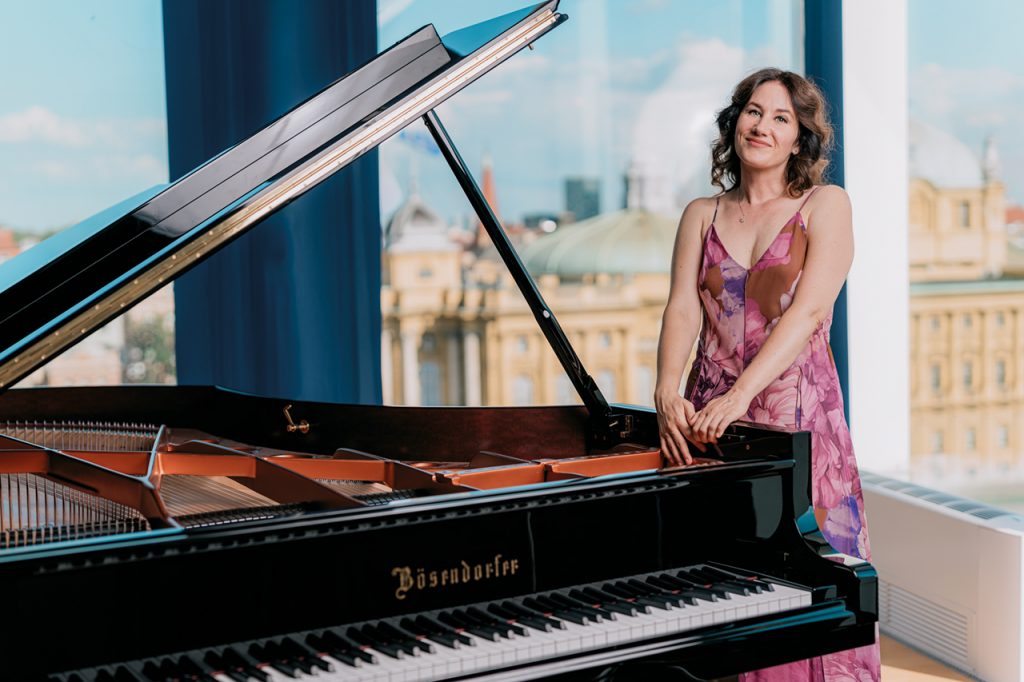
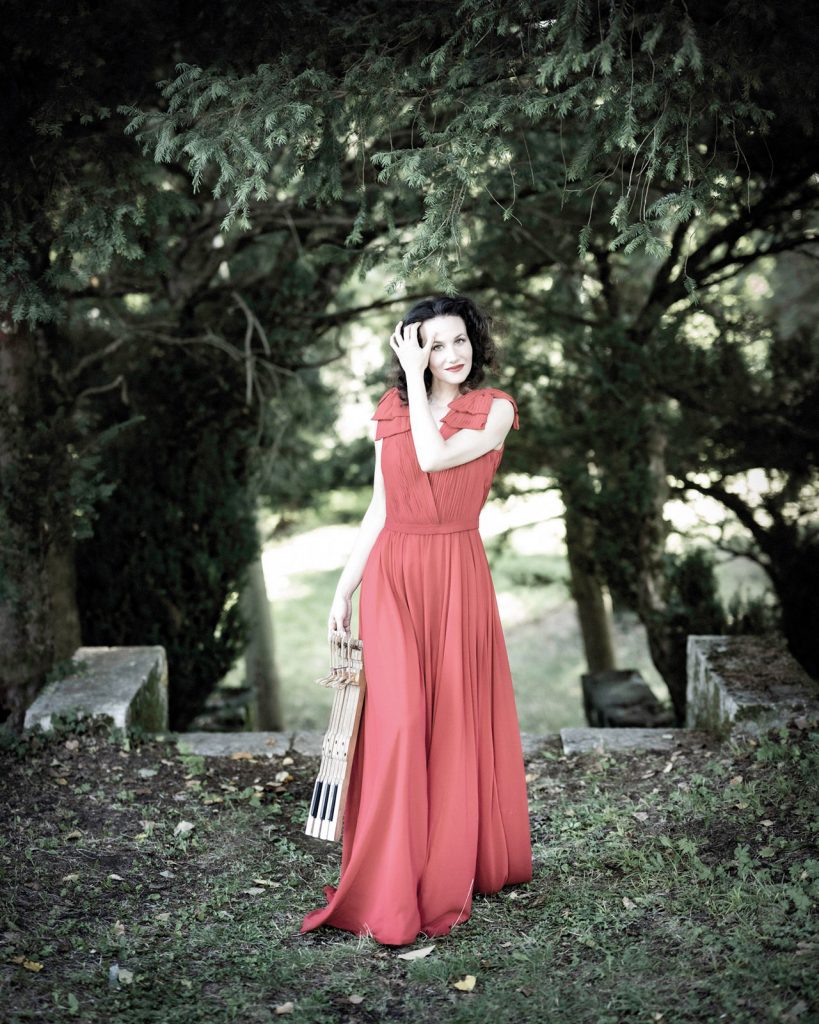
One of our most esteemed pianists with a relevant international career, Martina Filjak (46), is halfway through her first term as artistic director of the Dubrovnik Summer Festival. Since she has the reputation of being a pianist with excellent contacts and a superb overview of the world music scene, her appointment also meant that she would be bringing the top echelon of world musicians and orchestras to Dubrovnik.
She was born into a musical family, began learning piano at the age of five, and gave her first public performance at six. She received her musical education at the Music Academy in Zagreb and the Vienna Conservatory, later completing her studies in the renowned soloist class in Hanover. She also attended master classes at the prestigious Piano Academy on Lake Como in Italy.
She is the recipient of numerous awards and recognitions, including the „Vladimir Nazor“ Award for her performances of Brahms’s First Concerto and Kelemen’s Concerto, the „Milka Trnina” Award of the Croatian Society of Musical Artists, the „Orlando” for her performance at the Dubrovnik Summer Festival, the „Judita“ for her performance of Dora Pejačević’s concerto at the Split Summer Festival, and in 2009 she was decorated with the Order of the Croatian Interlace for her achievements in music.
She attracted the attention of the wider international public in 2009, when she won the gold medal and a series of special awards at the prestigious international competition in Cleveland, which typically receives about 5,000 applications from pianists worldwide. Shortly after, she debuted in Berlin’s Konzerthaus, Vienna’s Musikverein, and Carnegie Hall’s Zankel Hall, earning excellent reviews from music critics. Just before Cleveland, she had also won first prizes at the Viotti Competition in Vercelli, Italy (2007), and the Maria Canals Competition in Barcelona (2008), and had been a laureate at the Busoni Competition in Bolzano.
All these successes enabled her to perform with leading world philharmonic, symphony, and chamber orchestras on major concert stages across the globe, as well as to collaborate with some of today’s most renowned conductors.
You have already completed two years of your first term as artistic director of the Dubrovnik Summer Festival. Have you introduced any innovations or changes to the program?
When we talk about the Dubrovnik Summer Festival, we know we are speaking of a festival with a rich tradition; this year was already the 76th edition. It is known equally as a festival of dramatic theatre and classical music, but also of many interesting accompanying programs such as ballet, folklore, exhibitions, discussions… Naturally, a festival of such enormous national and significant international importance has its very firmly established framework, but that does not mean there is no room for creativity or a fresh impulse — quite the opposite.
Following the example of many world festivals and seasons, we introduced the principle of a festival theme as the general programmatic direction and guideline for each season, a conceptual thread that sometimes connects the various programs more strongly, sometimes more loosely.
Thus, in the first year we focused on the Mediterranean, and this year on women, women’s strength, and women’s creativity. Within those pillars, there is enough room for new steps and new moments. We noticed a good audience response to theatre plays and concerts for children; the small off cycle (jazz and world music) had an excellent turnout, as did the concert Young for the Young, a benefit concert whose entire proceeds go to young, award-winning students of the Luka Sorkočević Art School.
At the end of the second season, it was more than evident that Senka Bulić, as director of the drama program, brought a new freshness, passion, and sensibility, as well as an exceptionally carefully and wisely chosen drama program — best evidenced by the fact that it was sold out.
The concert performances were also completely sold out, with demand for 100 or even 200 standing places. Thus, ticket sales revenue in 2025 increased by as much as twenty percent.
What has been your most difficult, and what your most beautiful experience so far?
I would say that sometimes, when watching or listening to a performance, I feel more nervous than when I play myself. Still, I have complete trust in the top-notch, extremely professional team of the Dubrovnik Summer Festival, which is now even stronger and more cohesive, without whom nothing would be possible.
On the other hand, having been an independent artist for many years and having performed in Dubrovnik several times, I know how difficult it is to play in high temperatures, with lots of humidity, and the other challenges that come with summer concerts. So with every artist who performed, I was breathing with them, hoping, worrying, and rejoicing with them.
We always want Dubrovnik to be one of those places where artists feel so good that they reach that level of concentration and relaxation to give us an unforgettable, fascinating, and unique performance.
The list of international musicians and orchestras who have performed over the past two years is truly impressive, though I know there are still many more you would like to bring to Dubrovnik. Is scheduling conflicts with tours and booking several years in advance the biggest problem?
I don’t think that’s an insurmountable problem — for certain names, that is a well-known fact. Of course, some artists are not always available or are occupied with other types of tours, for example with large orchestras. However, personally, I believe that this early booking actually works very much in our favor; I know the system very well and have adapted to it.
Unfortunately, there are also some who simply do not want to perform outdoors. For example, one of my favorite pianists, Grigory Sokolov, or violinist Viktoria Mullova…
From the concerts I attended, I would say you clearly decided to define the program according to quality. In other words, you invited world musicians who maintain a high standard of interpretation, not primarily big names living off past glory?
Absolutely correct. For me, in terms of the music program, it is important that Dubrovnik hosts artists with careers that are current and happening now, musicians who are a living creative force in the present time.
Our society in general sometimes lags behind world trends, although even that is changing thanks to globalization and the internet age, which so many dislike. But I would certainly say that the audience’s contact with artists whose careers are fresh and have developed in real time provides a precise insight into a special level of quality — a level that is necessary today, because only thanks to it can the performing arts remain alive.
How do you deal with human vanity? Surely there is a long list of artists who believe they must unquestionably be invited to the Festival, without any self-criticism?
It’s hard for me to say whether it is exclusively vanity, or also a kind of habit and hunger for that kind of spiritual and energetic nourishment. Or perhaps it is the desire for life energy which, without the stage, only smolders…
When someone has been performing their whole life, it is hard at one point to say ‘stop.’ And very few maintain the same level of perfection in later years.
Although, one must admit, there are also artists who bring something else: a maturity and a special approach that goes beyond youthful energy, and that is sometimes equally desirable.
I constantly recall last year’s interview with the great Latvian mezzo-soprano Elīna Garanča, who, still in her forties, confidently explained how she plans to withdraw completely from the stage in a few seasons and has actually been planning the end of her career for some time. To the shocked question „But why?“, Garanča answered that she wants to stop when she is at her peak. Certainly a radically different approach from the one we had just been talking about…
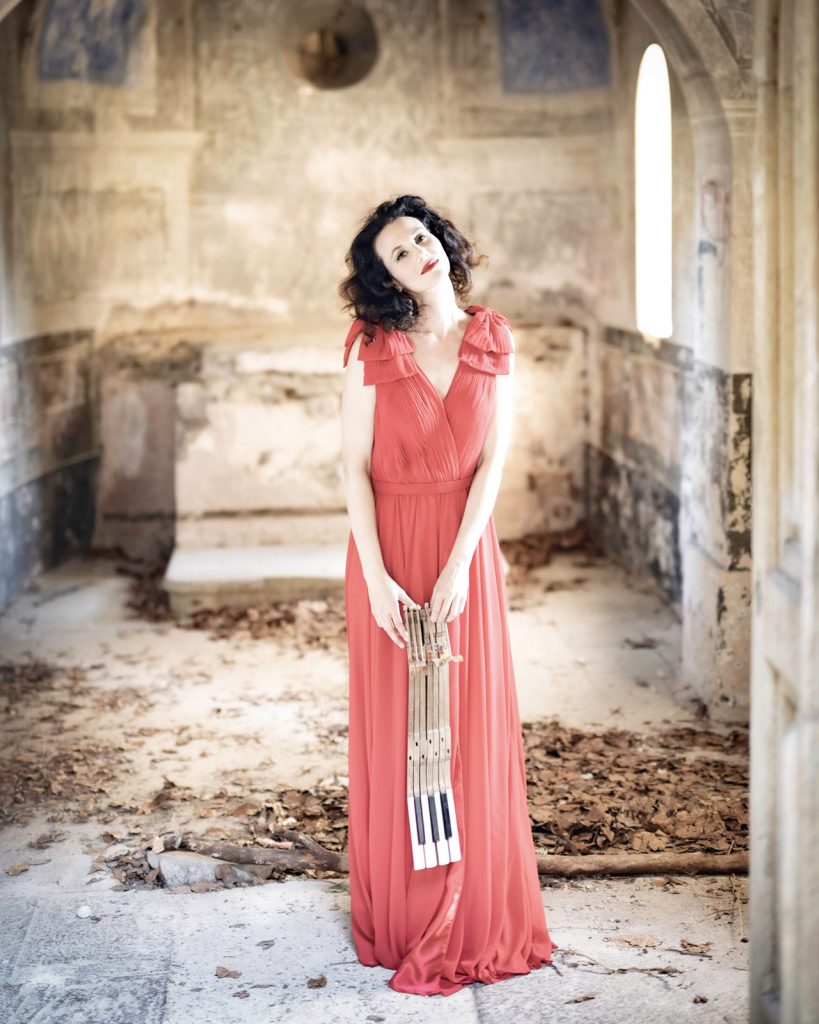
Is it difficult for you to balance your international solo performances with your obligations in Dubrovnik?
Working with the festival is year-round work. From program planning (sometimes two to three years in advance), defining each individual concert program, to dealing with last-minute details. Of course, an important aspect is also coordinating the wishes and plans of drama director Senka Bulić and myself.
Naturally, we are always grateful to the Ministry of Culture, the City of Dubrovnik, and Dubrovnik-Neretva County for their support and help, and I am especially grateful to the entire team — Marijeta, Nikolina, Mara, Lina, Mirna, Dajana, Andrea, Đeki, Vinko, Maro…
In this whole context, my piano performances „coexist“ with the Festival. These are two completely parallel tracks that do not intersect.
What are your plans, are you already thinking about the next mandate?
I am only halfway through my mandate, and it is impossible to say what will happen next. I believe that for institutions and festivals like the Dubrovnik Summer Festival, a change of artistic leadership can also be a very healthy and desirable moment, because after some time saturation inevitably occurs.
At the halfway point of my current mandate, it is much more important not to lose focus on the set quality, and to see how this second half can achieve new artistic moments, challenges, and peaks.
And your piano career? What awaits you in the near future?
After recent performances at the Palau de la Música Catalana in Barcelona and the Palau de la Música in Valencia, I am very much looking forward to upcoming performances in my hometown of Zagreb.
I am also looking forward to the release of as many as three recordings this season, two of which are dedicated to Dora Pejačević. One will be released by Croatia Records, another by the German label Audite, and the third by the German label cpo on the occasion of the 120th anniversary of the birth of Boris Papandopulo.
Can you reveal a glimpse of what you are preparing programmatically for the next Dubrovnik Summer Festival?
It is an exceptional pleasure for me to already be able to announce a performance by the Academy of St Martin in the Fields orchestra, together with their artistic director, the legendary violinist Joshua Bell. I have been working on this guest appearance for two years, and we recently signed the contract. We expect them in Dubrovnik on July 14, 2026!