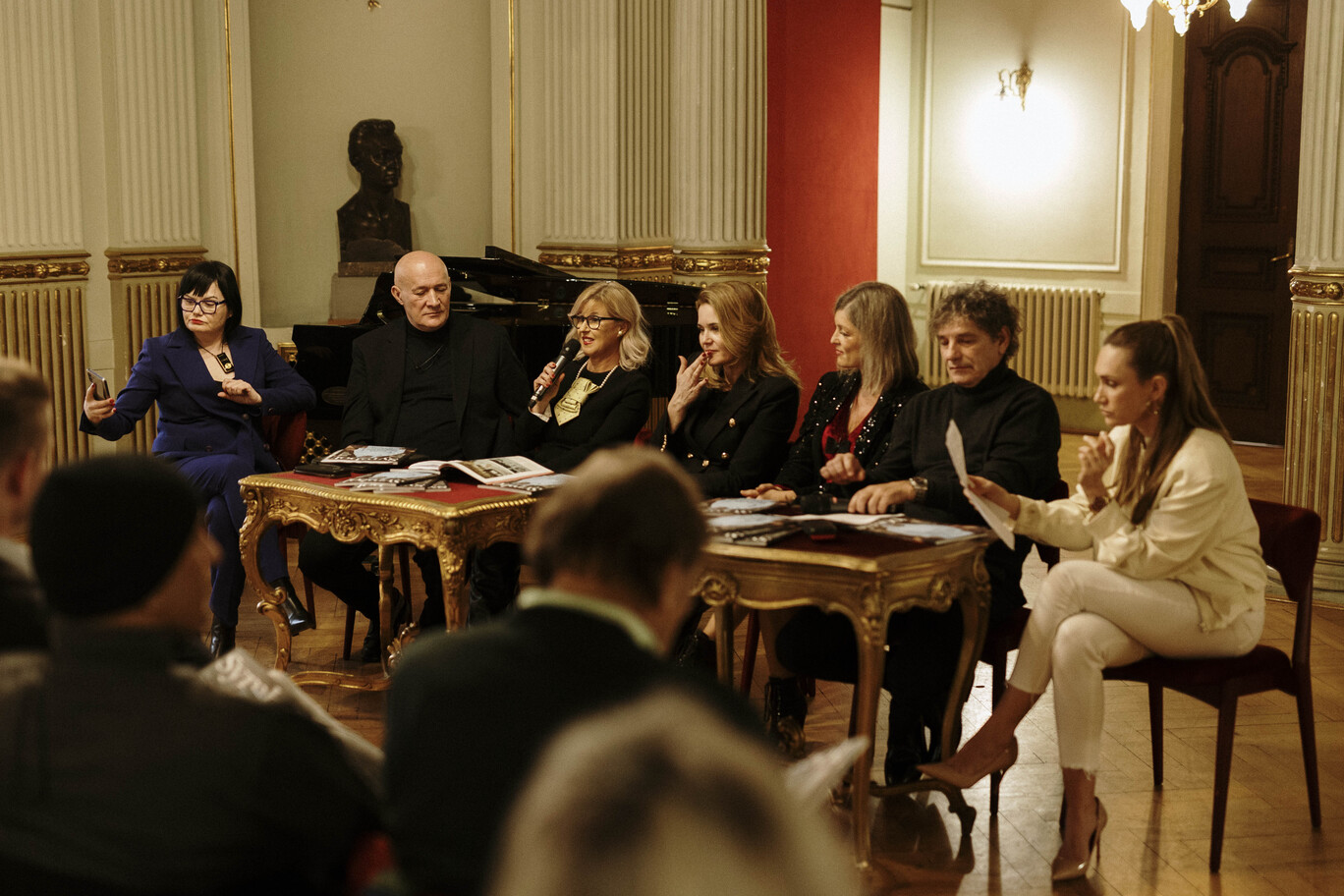
Written by: Gea Vlahović
Photos: Tomislav Marić
…
History is written by the victors, but art can tell it from a different angle – from the perspective of the individual, from forgotten fragments, from the emotion that cannot be recorded in archival documents.
This thought aptly reflects the film work of Jakov Sedlar, a director unafraid to delve into the cracks of history and question the narratives that have shaped our collective consciousness.
Born in 1952 in Split, Sedlar began his career in theatre before establishing himself as one of the most well-known Croatian filmmakers specializing in historical and political themes. He has worked in Israel and the United States, collaborating with renowned actors and producers, and has directed a number of documentary and feature films, often dedicated to key moments in Croatian and world history. His films frequently provoke strong reactions – ranging from admiration to fierce debate and criticism – but one thing is certain: Jakov Sedlar leaves no one indifferent.
As we await the premiere of his latest film “260 Days”, which tells the story of the Gubin family who endured the horrors of captivity and forced labour in the eastern Slavonian town of Dalj during the Croatian War of Independence, Sedlar has assembled a stellar cast led by Hollywood star Tim Roth. In an interview with Symbol, Sedlar reveals what drew him to this subject, how he approaches historical events on film, where he draws the line between artistic interpretation and documentary responsibility, and how he views the controversies surrounding his work – as obstacles or as confirmation that he is tackling topics that still burn.

When choosing the stories you want to tell on film, what drives you the most: the emotional strength of the story, its historical significance, or the visual potential you see in the material?
It’s always a combination, but if I had to name the decisive factor, it would be the story’s potential emotional power. Emotion is what drives everything important in life – and that includes film stories. Reason, of course, isn’t insignificant, but still…
As a director who often works with historical themes, how do you balance facts and artistic interpretation? What are the challenges of portraying controversial topics on film, especially in the context of Croatian history? Is there a point where historical accuracy must give way to dramatization?
When dealing with historical themes—especially in documentaries—facts must never be bypassed. There’s always a way to approach a subject in your own way and make it personal, but if you ignore the facts, then your personal vision lacks the power such a work should have.
To me personally, nothing is controversial, even though many of the projects I’ve worked on have been labelled as such. I think our society still hasn’t matured enough to accept circumstances and life as they truly are, with all the good and bad. I’ve worked on subjects like Stepinac (even during communism), Tuđman, Tito, Pavelić, and Israeli leaders such as Sharon, Barak, Hod, Amit… For me, these were above all challenging destinies and characters who shaped history in very delicate situations.
Each of them did what they did, and I tried to offer viewers what I personally found most interesting about those characters and the circumstances that shaped them—just as they, in turn, shaped the circumstances.

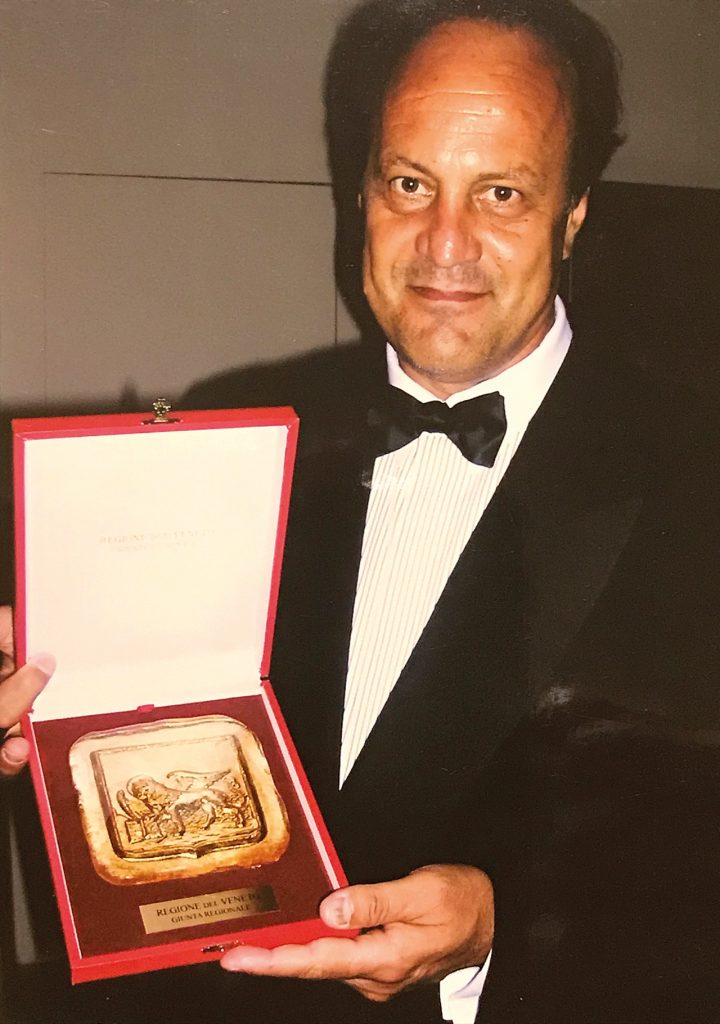
“SYNDROME JERUSALEM” (VENICE, 2004)
Your work often provokes strong reactions—ranging from high praise to sharp criticism. How do you cope with such polarized perceptions of your creative work? Do you believe an artist should provoke, or is it more important to build consensus?
I never think about whether one of my films will be praised or criticized. Always—absolutely always—I try to put the best part of myself into the stories I want to tell, so I have no issues with my conscience or any potential manipulation of a subject. I care little about consensus, especially when it comes to so-called political correctness. I sign my films, and I stand behind them, regardless of criticism. I’ve never depended on reviews in the sense of whether or not I would get another job based on the current success or failure of a film, because I’ve always found subjects that intrigued people willing to invest in film—and I believe that’s key. After all, someone may have a brilliant idea, but if there’s no one to back it financially, then it’s a dead idea.
It’s happened to me too—having a “brilliant” idea, but with no one to support it, so I moved on. That doesn’t mean I gave up on it. For example, I still want to realize my favorite short novel, Tonio Kröger by Thomas Mann, but whether I’ll ever succeed—I don’t know. I have the same passion for that potential film now as I did 30 years ago when the script was written.
You’ve worked with many global acting stars. Who left the strongest impression on you, and why?
It’s a great blessing to work with true greats, because Martin Sheen, Michael York, James Earl Jones, Derek Jacobi, Kevin Spacey, Tim Roth… they didn’t become legends just because someone declared them so after starring in a soap opera—they earned that status through immense talent, hard work, and real success. Each of them (along with several others I’ve worked with) is fascinating in the way they work, their personalities, their knowledge, and the human way they interact with others.
For instance, Martin Sheen preferred to travel around Zagreb by tram, because it allowed him to observe how people behave and react, to hear the language, and sometimes even chat with someone who recognized him.
Kevin Spacey is a top-tier intellectual with fascinating knowledge! Ask him about the best spaghetti, the best restaurant in Hawaii, or to recite a Shakespeare monologue—he’s ready to answer any of that on the spot without hesitation.



It may be less known that in your youth you were actively involved in sports—you played water polo for the Yugoslav national team. How did that experience influence your later artistic work? Is there something from the sports mindset—discipline, teamwork, competitive spirit—that you carried over into your approach as a director?
Sport is a key part of my life—it definitely shaped my character. My father was a baker in Split, and I had nothing except a group of friends on my street in the middle of Marjan, but the pool was only five minutes from my house, so I became a member of “Jadran” at an early age.
Going through all the ranks—from junior categories to first-team player and national team member, and eventually becoming the starting goalkeeper for the world club champion, Zagreb’s “Mladost”—I realized that the key element in any job is being aware of whether you’re truly capable of doing what you’ve chosen. And if you are, then there are no limits in work and perseverance. There’s no stopping or giving up—that’s never an option.
Sport, of course, also taught me how to lose (though that didn’t happen often, since the teams I played for were excellent), and that’s a very important life lesson. Everything I learned in sports has had a major impact on what I’ve done and what I will do. Honestly, I believe sport is much fairer than art, because sporting results are measurable—you see them immediately—while many artists were only recognized after their deaths.
We are now anticipating the premiere of your latest film, “260 Days,” which tells the story of the Gubina family during the Homeland War. Among others, the film stars Tim Roth, a major name in world cinema. How did you attract him to this project, and how did he, as a foreigner, perceive the story of the Homeland War?
The film is finished, and I believe it’s the best film I’ve ever made. At its core is the fascinating life story of Marijan Gubina. My son Dominik wrote an excellent script, and the team we managed to assemble is truly outstanding. Of course, the legendary Tim Roth is the most prominent name, and he came on board in the usual way when dealing with actors of that level. First, you need a script that both he and his agent like. Then they ask who is directing the film, and if that checks out—you need to have the money. And finally, there’s the issue of whether he’s available.
He liked everything, but was especially moved by the wartime story of young Marijan (Roth plays the adult Marijan), who, along with his family, endured immense suffering during 260 days of enslavement by a Serbian family in 1991. We spoke a lot about the war, and he was particularly pleased that the character he portrays carries no spirit of revenge (even though he certainly could), but is instead a man dedicated to making sure such a situation never happens again—anywhere.
Roth watched a great deal of documentary footage and learned about everything our people went through during those hard times. His performance and the way he brought the character to life are incredible. He is a truly special actor, a living legend, one of the greats, and his appearance in the film is an enormous asset to the entire project.

The involvement of international actors raises the question of the story’s universality. Can a film about the Homeland War truly transcend national borders and become relevant in the global discourse on war trauma? What kind of reactions do you expect outside of Croatia?
This is a universal story, one that could easily happen today—in Ukraine, for instance. In every war, the innocent suffer the most, especially children. Suffering is universal, particularly the suffering that comes with war, so there are no barriers in that sense. That’s why the English language isn’t an obstacle either, and the quality of the performances by excellent American and British actors (along with four outstanding Croatian actors) can only enhance the clarity and emotional impact of the story.
I expect that international audiences—those outside Croatia—will, for the first time, be able to truly see how the Homeland Defence War began. A film like this, with a cast of this calibre, has never been made before.
Historical themes often walk a fine line—between moral responsibility to truth and artistic freedom of interpretation. In 260 Days, did you rely more on authentic testimony, or did you intentionally dramatize certain parts to achieve a stronger emotional effect?
260 Days is based largely on real events. The only dramatized parts are the links between individual scenes, intended to make the narrative clearer. But in many segments, the film will feel almost like a documentary. Moral responsibility is always present, especially with themes like this. In this case, it was even more so—because the central figure, Marijan Gubina, was often on set during filming.
Film has always been a powerful medium in shaping cultural myths and collective memory. Do you believe that in today’s society, film still holds that power, or has it been overtaken by other media and forms of storytelling?
Film has always had that power, and I believe it always will. There’s something mystical about film—something people love, long for, and dream about. That’s why there’s so much debate and controversy around many films. Because in every person’s consciousness live images from films like Gone with the Wind, The Godfather, Cabaret, Citizen Kane, Se7en… I don’t think there’s a single person on Earth who hasn’t imagined themselves as a film hero. In fact, a huge number of people want to work in film for precisely those reasons. Film is truly a magical art form, one that people will never grow tired of. Television has tremendous power, but I would say it’s prose—while film is poetry.

Many of your films deal with the fates of individuals caught in major social and historical upheavals. How important is the psychological dimension of characters in your films, and how much time do you spend researching their inner worlds before shaping them on screen?
Character research is a demanding but necessary part of any film that deals with figures caught in great historical turmoil. Today, it’s much easier because of the internet, but even so, one must be cautious, as a lot of information is inaccurate or deliberately distorted. That’s why researchers are often key in the preparation process for such projects. To portray a complete picture of a person, you have to know many things that might not even be shown in a scene—but you’ll express them in another way. That research phase can be absolutely crucial.
If you could make a film about any artist in history—regardless of budget or limitations—who would it be and why?
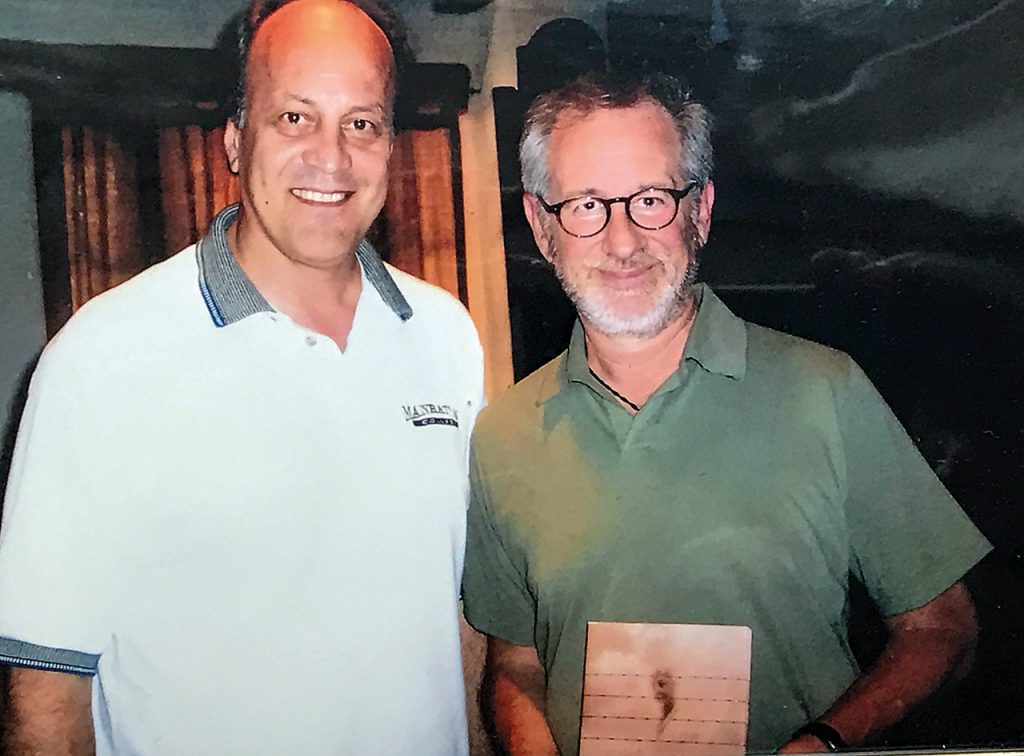
That would definitely be Orson Welles. A true Renaissance man, about whom I (together with my son) made a documentary film that featured Steven Spielberg, Frank Marshall, Paul Mazursky, and of course Oja Kodar, the love of his life. His life and everything he left behind is fascinating and unrepeatable. The greatest film figure of all time!
In the era of streaming platforms and digital distribution, how do you see the future of cinema? Can film still be experienced as a collective experience, or are modern technologies inevitably pushing us toward individual viewing?
For me personally, film has always been a very individual experience when it comes to viewing. That’s why I love the movie theatre—not watching films on television. I don’t like talking or being interrupted in any way during my connection to what I’m watching. Even though today it’s possible to watch films on a mobile phone—and who knows what’s next—cinema remains something magical to me, and I wouldn’t trade it for anything.
Given your extensive experience in directing, what advice would you give to young filmmakers in Croatia today? What are the biggest challenges, and where do you see room for innovation?
Freedom is the most important part of our existence. Spaces of freedom are limitless—they give us the most natural thing of all: the ability to realize our dreams. That’s why I believe the most important thing for young directors is not to become slaves to a system that gives non-refundable funds but doesn’t care about results, which is often the case here in Croatia.
A young person has endless energy and passion (if they’re truly meant for this), and no system can set limits that will control you. Receiving state funding can create a false sense of comfort, but the true meaning of our work is the fight for a better world and for dreams—whatever those dreams may be. Successful directors are good merchants of dreams.

You’ve spent nearly half a century actively working, with an extensive filmography and a significant number of theater productions under your belt—but it doesn’t seem like you’re ready to stop. What would it take for you to feel satisfied enough to retire from directing? Do you think that will ever happen?
I will never retire—ever! If someone said to me: “Here’s as much money as you want, here are all the riches of the world—but you have to stop doing your work,” I would politely decline. My work is the meaning of my existence. That’s how I’ve always thought and how I’ve always lived.
Looking back on your rich career, what are you most proud of?
There are films I’m prouder of than others—though I love them all—but some I would probably do a bit differently today. However, I absolutely don’t want to overlook my quarter-century at the Croatian National Theatre, especially the time when I was Head of Drama.
It was a difficult time—the war years—when, together with the general manager, the great Georgij Paro, and the heads of ballet and opera, Milko Šparemblek, Almira Osmanović, Igor Kuljerić, and Vladimir Kranjčević, we maintained a remarkable repertoire at the highest level through superhuman effort. I led the HNK Drama ensemble on three unforgettable world tours across North and South America, South Africa, Australia, and Europe. Representing Croatia’s largest and most important theater were legendary actors like Vanja Drach, Tonko Lonza, Neva Rošić, Ena Begović, Boris Buzančić, Ivo Gregurević, Mustafa Nadarević…
For the first time, Croatians abroad had the opportunity to see the best actors of their homeland perform live, and those actors, in the midst of war in Croatia, had the opportunity to appear on stages in New York, Los Angeles, Toronto, Buenos Aires, Johannesburg, Melbourne, Sydney…I often think back to that truly heroic time, when none of us knew what tomorrow would bring, yet we were ready for anything. The collaboration with acting and directing giants—who, sadly, seem to have no true successors in today’s world—was simply unforgettable.