Written by: Gea Vlahović
Photos: Zlatko Gotovac
…
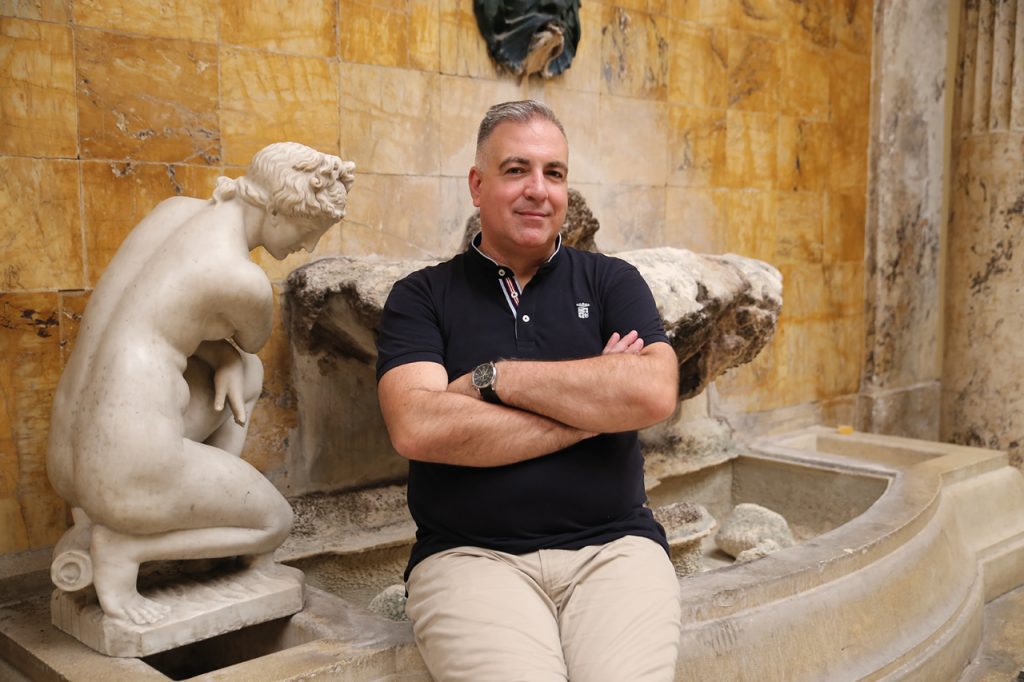
What connects London’s concert halls, Pantovčak, and a centuries-old hackberry tree next to the Pula Arena? The answer is – Petar Ćurić, one of the most versatile figures of the Croatian cultural and social scene. A musician, manager, cultural policy strategist and social activist, Ćurić has, over two decades of work, linked art, politics and ecology into a unique life path.
He studied in Great Britain and the USA, taught in London, launched the “Branding Croatia” conference and participated in the work of the presidential task force on national identity. He has received numerous international awards, and in 2024 he was decorated with the Order of the Croatian Interlace for his contribution to culture.
After leaving party politics, he shifted his focus to civil society and ecology through the initiative Against Logging! known for its fight to preserve urban greenery in Istria.
In every respect a true contemporary renaissance man, Petar Ćurić, in conversation for Symbol, talks about his formative experiences in Pula, London and Los Angeles; music as a school of discipline and collective work; branding Croatia and missed opportunities; and the blending of culture, politics and ecology into “green patriotism,” the role of civic initiatives and the challenges facing Croatian society today. He also revealed why he believes that the greatest change begins with the individual.
You grew up in Pula, studied in Great Britain, and advanced your education at American institutions such as CalArts and the University of Michigan. These are three very different cultural and educational environments. When you think about your path today, where do you feel you most shaped your own identity – in Istria, in academic London, or in artistic Los Angeles?
Every life experience becomes a part of us and over time grows into what we can call our own identity. Pula and Istria are my homeland, the place I come from and with which I am permanently connected. England, on the other hand, represented everything else – I am an English pupil. I spent six wonderful years there, and both my degrees, Bachelor’s and Master’s, are from English universities. America, however, was something that overnight shattered my youthful calm, and in my formative years – I was then not yet 17 – it restarted me, rebooted me, as if it installed some new software in me. I graduated from high school in the USA through an international student exchange, and later travelled it up and down during the additional three years I lived there.
I cannot say that one experience was more important than another; our life is a mosaic of everything that happens to us. All those experiences – that is us!
You began your professional path in music – in the Rijeka opera and philharmonic, and later as a professor in London. What did the musical experience give you in terms of discipline, creative imagination, or understanding of collective work? And how much did that formation remain the foundation of everything you later did in culture and politics?
Music is not only the performer who performs it. It is also the composer who writes it, the publisher who prints the notes, the studio that records the work, the radio that plays the recording, not to mention further….. The concert that the manager arranges, the producer who produces it, the media that announce it, the televisions that interview, and above all, the audience that comes to the concert – all that is music!
I can say that I went from performer and pedagogue to organizer, manager, producer… What always fascinated me was working with young talents, but also collaborating with some of the greatest authorities in the profession worldwide.
For example, because of the late John Bergamo (Frank Zappa), I moved from Canoga Park to Santa Clarita, where CalArts is located, the institution whose music program he founded. At that time, I also had the opportunity to work with Steve Forman (Pink Floyd, David Bowie) in his studio in Venice Beach. In London, I was fascinated by hanging out with Andrew Small, artistic director of Kylie Minogue and Massive Attack, while as a professor at ACM I taught a then-unknown Ed Sheeran, and my student Africa Green later became a permanent member of the Pet Shop Boys’ backing band.
Through an international project in Grožnjan I collaborated with Bill Bruford (YES, King Crimson), and at ACM with John Gallen, studio engineer who worked on the album A Night at the Opera and recorded Bohemian Rhapsody. Also teaching there was Sam Brown, known for the hit Stop.
I also had the honor to work with Steve Gadd (Eric Clapton, Paul Simon), Horacio Hernandez (Santana), Mike Mangini (Dream Theater), Gerald Heyward (Beyoncé, Mary J. Blige, Janet Jackson, Chris Brown), and I grew especially close with Piero Foschi, the drummer who recorded Jovanotti’s hits Penso Positivo and L’Ombelico del Mondo and Pausini’s Tra te e il mare. I remain in close contact with him to this day.
I would also highlight cooperation with Dieter Flury, longtime director of the Vienna Philharmonic, and more recently with Kersten McCall, principal flutist of Amsterdam’s Royal Concertgebouw, one of the best orchestras in the world.
As the initiator of the “Branding Croatia” conference and a member of President Kolinda Grabar-Kitarović’s task force on national identity, you took part in perhaps the most ambitious attempt to strategically position Croatia on the global cultural and political map. Looking back, what was the most important achievement at that time, and what was the missed opportunity?
After a decade of work in culture, it was natural to turn to public diplomacy – “soft influence,” the so-called “war in peace,” although even that phrase today seems somewhat worn out. Because, on one hand, we are witnessing the return of barbarism, and on the other, more advanced countries are already abandoning the concept of soft power, replacing it with cooperation based on mutuality and reciprocity. Public diplomacy, of course, includes culture, but also encompasses sport, economy, education…
The Branding Croatia project, which I launched ten years ago with Croatian-American musician and peace activist Nenad Bach, was actually the forerunner of the establishment of the Task Force for the Development of the Identity and Brand of the Republic of Croatia. It was established by President Grabar-Kitarović based on our lobbying. The team included almost all the lecturers from our conferences (Davor Bruketa, Boris Ljubičić, Božo Skoko, Zvonko Frka-Petešić…), but also experts I met for the first time then – for example, Dr. Dubravka Sinčić Ćorić, who was the coordinator, or our legendary designer and “spin doctor” Boris Malešević, with whom I still enjoy socializing.
Was it the most ambitious attempt to strategically position Croatia on the global cultural and political map?
Absolutely! We systematized guidelines, defined areas and directions for positioning Croatia, and established the content and architecture of the brand of the Republic of Croatia. But then the covid-19 pandemic came and the Branding Office was never opened…
Croatia is recognized worldwide through tourism and sports, but much less through culture and art. What are our cultural capitals that remain underutilized, and how could they be made more visible to an international audience?
Reluctantly I say this, but yes – Croatian recognition in the field of culture and art, although it undoubtedly exists, is far weaker because our artists and cultural projects are not systematically branded. I emphasize – systematically. Because that is the core of the problem. In the system.
That is why we also considered establishing a state agency or a special office modelled on Slovenia. There, management of the national brand is entrusted to the Government’s Communication Office (UKOM), which coordinates all ministries and state institutions to ensure consistent and effective application of the Slovenian brand across all sectors. That is how it is done.
Branding a state often sounds like a marketing task, but you have always presented it as a cultural and social transformation. Can we even talk about the brand of a country without serious investment in art, education, and research?
I will tell you a story. 2Cellos – Stjepan Hauser and Luka Šulić, and today only Hauser – are without comparison currently the most famous Croatian musicians on the world stage. Huge international popularity, they play in the biggest venues such as the Royal Albert Hall, they have millions of followers on social media, their videos have hundreds of millions of views. Just last month a video was released where Stjepan performs solo with Plácido Domingo, José Carreras and Dimash Qudaibergen – something like the “four aces” – top!
Since we are both from Pula, we had the opportunity to talk. And once I asked him – they had already exploded on the world scene and were filling arenas – “Stjepan, have you been contacted by the Croatian Chamber of Commerce, to maybe connect a little, so that after some of your most important concerts there could be a presentation of Croatian traditional products, or when world statesmen or celebrities visit you backstage that they are served some Croatian drinks or desserts?” He replied – no. I was surprised, so I added: “And if they contacted you, would that be acceptable to you?” He replied – yes, of course!
So, that is the best answer to your question. Without a system, there is no sustainable strategy. But even just a little goodwill can make a big difference!
You were vice president and general secretary of the National Committee for Culture of HDZ, and a councillor in Pula. Entering politics, especially party politics, requires compromise between ideals and reality. Looking back at that period today, where did you feel the greatest gap between your own convictions and political practice?
Since I have not been in politics for almost five years and I am not a member of any party, I would rather not speak about it – because perhaps I would say too much (laughs). The truth is that I was vice president of the Committee for Culture during the mandate of our celebrated actress Anja Šovagović-Despot, who was a non-party president and represented the profession. After her departure I became the first operative to the new president Krešimir Partl, already then state secretary in the Ministry of Culture – a function he still holds today.
From that time, I especially cherish the memory of Dr. Iva Hraste-Sočo, whom I greatly respect. She was also a member of the branding task force at Pantovčak, and her doctoral dissertation Croatia – A Nation of Culture is an excellent example of how festivals can serve as tools of cultural branding and international recognition of Croatia. We think very similarly.
You withdrew from party politics and redirected your energy toward civil society. Do you believe that civic initiatives and independent movements can achieve what political structures have not – real change in cultural and social policies?
Through civic initiatives, changes and concrete results are seen much more quickly. Here is an example from the last 24 hours: the civic initiative Against Logging!, which I launched with colleagues more than two years ago, with the help of citizens managed to put pressure on the local authorities and shut down a private investor’s construction site, thereby saving from liquidation the last old and valuable hackberry tree in the neighborhood, literally a few dozen meters from the Pula Arena! The effect is clear and tangible – we saved part of the city’s collective memory.
Centuries-old trees in urban environments should be strictly protected by law, not only for nature and health, but also because they are part of cultural heritage. This is often forgotten. That is why I laugh when someone asks me why a person who deals with culture and identity is so committed to the protection of trees. One does not exclude the other, on the contrary, they enrich and complement each other. It is about the same struggles, with the same people, around the same principles. For what is patriotism, if not love for one’s country? And what is a country, if not a healthy environment, nature, culture and heritage together?
I am convinced that the 21st century is the century of green patriotism. Our country is planet Earth. Let us take care of it. We have no other.
In practice we often witness conflict between the interests of urban development and environmental protection. Do you believe it is possible to achieve sustainable balance, or does social dynamics necessarily force us to constantly choose one side at the expense of the other?
Of course it is possible to achieve sustainable balance – it has no alternative. Things are simple. Urban development must not be in contradiction with nature conservation – it, actually, implies synergy between construction and environment, where old trees are not seen as an obstacle, but as valuable heritage, a microclimatic regulator and an element of the identity of a space.
The key lies in a change of awareness – of investors, architects and builders, but also of citizens in general. When that change matures, politics will quickly follow. Because politicians are often pragmatists: if they realize that something is opportune to win votes, they will act accordingly.
It is up to us citizens to tirelessly remind them of that.
You are the recipient of international awards in music, pedagogical work and cultural cooperation, and recently you received from President Zoran Milanović the national decoration Order of the Croatian Interlace for contribution to culture. How much do such recognitions mean to you personally, and how much do you see them as a symbolic signal from society about what it values and which people and ideas it chooses to reward?
Two quotes come to mind. The first is by George Bernard Shaw: “Everyone despises awards. Except when they receive them.” And the second is Krleža’s, which Rade Šerbedžija recently paraphrased: “Awards are welcome because they prove that what you did was worth something, but they should be forgotten as soon as possible, by the next morning.”
From my own experience I can say that once you have received both international recognition and domestic awards – at the level of the city, the county and the state – the appetite eases. That happened to me too: in 2020 I received the Medal of the City of Karlovac, in 2023 the Medal of Karlovac County, and in 2024 the national decoration of the Republic of Croatia. I am proud of all those awards.
Your work connects art, politics and ecology – three areas that in Croatia are often observed separately. If you had to name the greatest challenge of Croatian society today, one that requires a simultaneous response from all these spheres, what would it be?
Procrastination. “They will…,” “It should…,” “Someone should do…,” “Why doesn’t someone…?,” “I can’t…,” “It’s impossible…,” “If only times were different…,” “If circumstances were better…,” “If I had the chance…,” “If I were younger…” and so on, and so on. Feel free to keep listing excuses for your own inactivity.
The question may be whatever. But the answer is always the same – YOU! Because you can make a difference. Get active!
You often emphasize the importance of youth and education. What advice would you give to today’s students and young activists that best summarizes your philosophy of action?
Knowledge is the best investment – education is the most powerful weapon you can use to change the world. I think Mandela said that… I would add that knowledge is the only thing that no one can ever take away from you, resell, alienate, nor gamble away in a casino or smash on the road.
By raising your own awareness to a higher level, you raise and save the whole world.