Written by: Iva Stilinović Grahovac
Photos: Tomislav Marić
…
As permanent reminders of the lives and work of notable figures, these busts invite reflection on the achievements and lives of the people they depict. Created with great artistic skill, they add beauty to the Croatian National Theatre in Zagreb, representing a diverse range of artists whose careers have marked both national and international cultural history.
Zagreb’s HNK houses a total of 43 busts of renowned artists. The oldest, depicting Stjepan Miletić, was placed on March 24, 1931, a work by Ivan Meštrović. The second bust, of Marija Ružička Strozzi (by Fran Kršinić), is notable as the only one erected during the subject’s lifetime, on October 2, 1932. It was followed by busts of Andrija Fijan, Ivo Raić, Dimitrije Demeter, Josip Freudenreich…..
The most recent addition is the bust of Bojan Stupica, unveiled on June 28, 2021, created by Judita Šercar.
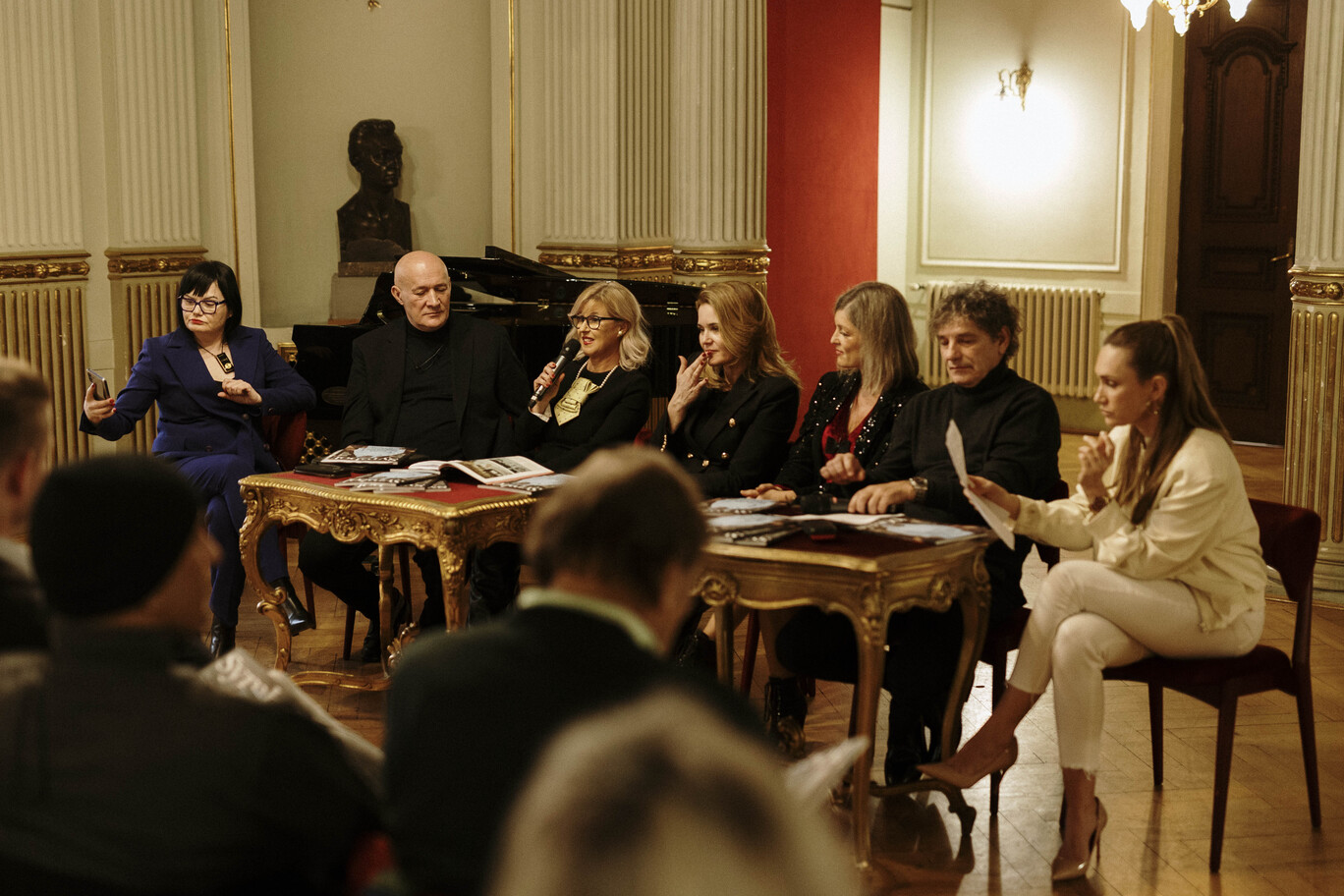
Sanja Ivić, a longtime dramaturge at HNK Zagreb now retired, has guided us through the most significant busts in this historic theatre. Below, we present them in chronological order of their unveiling…
STJEPAN MILETIĆ (1868–1908)
Sculptor: Ivan Meštrović
Bust unveiled: March 24, 1931
A Croatian theatre director, writer, and true lover of the theatre, Stjepan Miletić’s tenure as intendant of Zagreb’s HNK, from 1894 to 1898 (known as “Miletić’s era”), was a defining period in establishing the theatre as Croatia’s central cultural institution.
Miletić introduced the role of intendant, overseeing all work and operations of the institution. He made reading rehearsals mandatory, separated the roles of actor and director, established a ten-month theatre season, and, in 1895, moved the theatre to its new building (the current HNK building). He organized international guest performances, recruited new members for all ensembles, and modernized both drama and opera repertoires. Miletić founded ballet as an independent art form, established an acting school, updated technical equipment, funded translators, and introduced symphonic concerts and matinees for students and schoolchildren, among others.
Through his tireless efforts, Miletić profoundly impacted HNK Zagreb, leaving a legacy that benefited countless generations of theatre artists.


MARIJA RUŽIČKA – STROZZI (1850–1937)
Sculptor: Fran Kršinić
Bust unveiled: October 2, 1932
An actress and renowned tragedienne, Marija Ružička Strozzi initially trained for a career in opera at the Vienna Conservatory. However, while practicing demanding dramatic soprano roles, she lost her voice and abandoned her opera ambitions. She turned to acting, demonstrating remarkable talent. Although invited to join Vienna’s prestigious Burgtheater, she remained dedicated to Zagreb, becoming one of the city’s most celebrated actresses of her time. Her career spanned an impressive 68 years, earning her the title of “Croatia’s Sarah Bernhardt.” Strozzi’s memorable roles, including Adrienne Lecouvreur, Anna Karenina, Juliet, Desdemona, and many others, placed her at the pinnacle of theatrical excellence.
She performed widely across Europe, including in Ljubljana, Belgrade, and Mostar, and portrayed over 600 characters from various historical, stylistic, thematic, and genre backgrounds. She is the only stage artist to have a bust erected at HNK Zagreb during her lifetime.
MILKA TRNINA (1863–1941)
Sculptor: Vanja Radauš
Bust unveiled: 1971
One of Croatia’s greatest opera singers, Milka Trnina studied at the Vienna Conservatory and made her debut in Zagreb in 1882 as Amelia in Verdi’s Un ballo in maschera. Her stellar international career began the following year, with performances on the world’s foremost stages, from London’s Covent Garden to the Metropolitan Opera in New York. Known as one of the finest interpreters of Wagnerian music, Trnina also had an extensive repertoire, which even led composer Puccini to declare that no Tosca could match her portrayal of his tragic heroine. She was celebrated across Europe and often referred to as “the singing Eleonora Duse.”
Trnina also dedicated herself to teaching, with Zinka Kunc, a future opera star, among her students. A pioneer in advocating for environmental preservation, Trnina has a waterfall in Plitvice Lakes named after her, as well as an award given by the Croatian Association of Music Artists in her honour.


BRANKO GAVELLA (1885–1962)
Sculptor: Antun Augustinčić
Bust unveiled: April 8, 1982
Branko Gavella was a Croatian theatre director, educator, critic, and translator. After earning his doctorate in Vienna, he began directing at Zagreb’s HNK in 1914, later serving as Drama Director (1922–1926) and also directing at the National Theatre in Belgrade. His influence extended across Yugoslav theatre, including performances at the Dubrovnik Summer Festival and theatres in the Czech Republic, Slovakia, Bulgaria, and Italy. Gavella directed 279 drama and opera productions, with notable works by M. Držić, I. Gundulić, M. Krleža, M. Begović, L. Pirandello, W. Shakespeare, M. P. Mussorgsky, and R. Wagner.
He founded the Academy of Dramatic Arts in Zagreb in 1950 and co-founded Zagreb Drama Theatre (1953), now known as Gavella Drama Theatre. His comprehensive directorial style places him among the elite of modern European theatre directors. His teaching legacy is equally important, having trained generations of directors and actors who would dominate Croatian stages for decades.
TITO STROZZI (1892–1970)
Sculptor: Ivan Sabolić
Bust unveiled: 1983
Tito Strozzi was a giant of Croatian theatre—an actor, director, playwright, translator, and educator. He joined Zagreb’s HNK in 1919. Initially renowned for his portrayals of young lovers and refined seducers, he soon distinguished himself with his character portrayals in classic dramas, including W. Shakespeare’s Richard III and Hamlet, F. Schiller’s The Robbers, and several works by M. Krleža, such as Leda (Oliver Urban) and The Glembays (Leone Glembay).
Strozzi directed both Croatian and international classics, contemporary European plays, older Croatian dramas, and conversational comedies. In opera, he contributed to modernizing the genre by selecting lesser-known works by Verdi. His brilliant translation of Goethe’s Faust established him as one of Croatia’s most respected translators from German. He also authored numerous prose works and plays, including Ecce Homo, Murder on Stage, The Chameleons, Alenka, Zrinski, Tomislav, and his most-performed play, Game for Two.
Each year, HNK Zagreb awards the Tito Strozzi Award, established in 1993, to recognize the most outstanding individual achievement in the previous season at the Croatian National Theatre in Zagreb.

BORIS PAPANDOPULO (1906–1991)
Sculptor: Josip Marinović
Bust unveiled: October 16, 1996
Boris Papandopulo, a Croatian composer, and conductor, studied composition in Zagreb and conducting in Vienna. He created one of the most extensive bodies of work in Croatian music, composing numerous orchestral, chamber, stage, secular, and religious cantatas, as well as music for theater and film.
Notable works from his vast repertoire include the operas Sunčanica, Amphitryon, Rona, Fire at the Opera, and Madame Buffault; ballets like The Three Cavaliers of Miss Melanie, Teuta, and Gold and the King’s Son; the choral work Croatian Mass; and cantatas such as Hymn to the Sun, Poljica Mass, Osor Requiem, Marul’s Song, and Istrian Frescoes, among many other choral and chamber compositions.
Papandopulo’s unique musical style continuously interwove themes from literature, poetry, and folk motifs, characterized by rhythmic energy reflective of Croatian folk music. However, he was never confined by tradition, enriching Croatian culture with his daring and innovative musical visions.
MIROSLAV KRLEŽA (1893–1981)
Sculptor: Andrej Grabovac Gaberi
Bust unveiled: January 30, 1997
Miroslav Krleža was a playwright, poet, novelist, essayist, and encyclopaedist, as well as the founder of the Lexicographic Institute in Zagreb, which now bears his name. One of Croatia’s greatest writers, he produced an extensive body of work that spans poetry, plays, novels, essays, and numerous polemics, covering virtually all major literary genres.
His most significant works include Ballads of Petrica Kerempuh, a masterpiece of poetry in the Kajkavian dialect; the Glembay cycle of plays (The Glembays, In Agony, Leda), which premiered at HNK Zagreb; and novels such as The Return of Philip Latinowicz, The Banquet in Blitva, On the Edge of Reason, and The Banners.
Krleža’s remarkable erudition, intellectual curiosity, and vast knowledge of diverse fields of human creativity enabled him to craft a worldview that remains profoundly relevant today, with eloquence, prophetic insight, and meticulous analysis of Croatian and global history and politics.


VLADIMIR RUŽDJAK (1922–1987)
Sculptor: Kruno Bošnjak
Bust unveiled: January 3, 1998
Vladimir Ruždjak, a Croatian baritone opera singer, director, music educator, and composer, was one of the most versatile Croatian opera artists, leaving a significant mark on the latter half of the 20th century. After graduating from the Zagreb Music Academy, he made his professional debut at HNK in 1947 as Yeletsky in Tchaikovsky’s The Queen of Spades. His domestic and international opera career spanned over 40 years, distinguished by an exceptional vocal quality, musicality, superior technique, and powerful dramatic performances. From Verdi’s Rigoletto, Il Trovatore, Un ballo in maschera, and La Traviata, to Offenbach’s The Tales of Hoffmann, Puccini’s La Bohème, and Britten’s The Rape of Lucretia, Ruždjak captivated critics and audiences alike on major opera stages across Europe and the United States.
One of his most iconic roles was the title character in Ivan pl. Zajc’s Nikola Šubić Zrinjski. Ruždjak also composed instrumental and vocal works, often infused with Croatian folk motifs.
MARIJANA RADEV (1913–1973)
Sculptor: Kruno Bošnjak
Bust unveiled: November 28, 1998
Marijana Radev, a Croatian opera singer (mezzo-soprano) of Bulgarian origin, studied voice at the Zagreb Music Academy and made her debut in Trieste in 1937 as Marina in Mussorgsky’s Boris Godunov. In 1938, she debuted at HNK Zagreb as Santuzza in Mascagni’s Cavalleria Rusticana, earning widespread acclaim for both her singing and acting. She performed extensively throughout Europe, and in 1940, she first portrayed one of her most celebrated roles—Bizet’s Carmen, which she continued to perform internationally. Her portrayal of Carmen at HNK Zagreb spanned over 80 performances across 25 years. Following one performance, critics noted that she “ignited a flame of enthusiasm… Her Carmen seems to us the ideal embodiment of the character. Her extraordinary artistic achievement should be an example for all our opera artists.”

ENA BEGOVIĆ (1960–2000)
Sculptor: Kuzma Kovačić
Bust unveiled: March 27, 2002
Ena Begović was a renowned Croatian theatre and film actress. She graduated from the Academy of Dramatic Art in Zagreb in 1983 and joined the HNK Zagreb Drama Ensemble as a permanent member in 1984. At the national theatre, she distinguished herself in classic roles such as Desdemona in Shakespeare’s Othello, Miss Julie in Strindberg’s Miss Julie, Gertrude in Hamlet, and Hedda Gabler in Ibsen’s play. She also performed in 20th-century dramas, particularly excelling in Krleža’s works with roles such as Baroness Castelli in The Glembays, Laura in In Agony, and Klara in Leda. Apart from theatre, Begović was a successful film and television actress, earning her the status of a media and acting star of HNK. She performed beyond her home stage at events like the Dubrovnik Summer Festival, with the Histrion Acting Company, and at Split Summer Festival.
Tragically, she passed away in a car accident in 2000, having played over 100 roles and leaving an indelible mark on Croatian theatre.


ANA ROJE (1909–1991)
Sculptor: Jozo Vrdoljak
Bust unveiled: June 27, 2011
Ana Roje was a celebrated Croatian ballerina, choreographer, and pedagogue. She began her ballet training in her hometown of Split and continued in Zagreb under Margareta Froman. Together with her husband, Oskar Harmoš, also a ballet artist, she furthered her studies in London. Starting in 1938, she taught at prestigious ballet companies like Ballet Russe de Monte Carlo and Colonel de Basil. Alongside her husband, Roje directed ballet in both Split and Zagreb, eventually becoming a principal dancer at HNK Zagreb.
Her illustrious career saw acclaimed performances in ballets by Tchaikovsky, Stravinsky, Lhotka, Asafiev, Prokofiev, and others. She founded the International Ballet School in 1953 in Kaštel Kambelovac (which moved to Primošten in 1970). She also held ballet workshops in the United States, returning to Split in her later years. Roje trained many distinguished ballet dancers who went on to perform on national and international stages.

MIRKO BOŽIĆ (1919–1995)
Sculptor: Ivan Sabolić
Bust unveiled: May 2, 2015
Mirko Božić was a Croatian writer and theatre director. His early works were short plays based on partisan life, followed by novellas and stories focused on the psychological complexities of his characters. His greatest success was the trilogy The Kurlans, portraying the hardships and fates of people in Dalmatian hinterlands. He also wrote publicist articles and critiques. At HNK Zagreb, he served as Drama Director (1952–1954) and became the theatre’s intendant in 1965. That same year, he began extensive preparations for a major theatre renovation, which started on February 1, 1967. During the renovations, HNK’s ensembles performed across various venues in Zagreb and toured other cities, ensuring continuous artistic activity.
The grand reopening was held on November 27, 1969. For his contributions to the modernized building, which became one of the most advanced theatres in the region, Božić was awarded the title of HNK Zagreb’s honorary intendant for life.